Showing posts with label progress. Show all posts

Friday, June 10, 2011

Ode to Pablo

Yesterday, I experienced one of the most gratifying experiences of my life.

I was sitting in my brothers room and noticed he had an acoustic guitar leaning against his wall. This guitar is in rough shape: it's missing a string, it goes out of tune easily, it's hard to play and is generally the butt-end of a lot of instrument jokes in that house (they've been contemplating selling it for probably three years by now).

So, like most instruments I see, I picked it up and began to tinker with it. The guitar was sorely out of tune. I actually can't imagine a guitar going that out of tune naturally on it's own. So for the first time in my life I attempted to tune it on my own without the assistance of an electronic tuner.

Doing this is somewhat a tricky task even for experienced ears. Most often you begin with the A string (the second-lowest string before hitting the low E), mainly because it is least likely to go out of tune on a guitar. Didn't matter much anyway, it sounded tuned up to almost a C. This is where the gratifying part began.

Years ago, we used to play a game where there would be one person striking a chord, and two others blindly guessing what it could be. The easy part about this game is that chords are normally strummed downwards and you can assimilate certain chords from others by how they "ring-out", meaning that most guitarists know what the high E and B strings sound like when played together, so if you hear those two played you can assume the chord struck was in the range of E,A or B. This can be easily heard on guitars - unlike pianos which resonate more as tones rather than the plucking of strings. However, you can't tune a guitar by strumming a chord (actually you can it's just very, very hard to do). So you have to begin with single strings.

Beginning with the A string, I tried to hear an A chord in my head. I always thought the easiest way to do this was to just recall a song that opens with an A chord (a million songs do, pick your own). Then, it may sound odd, but you have to tune it to your memory by playing the note over and over in your head until the sound you visualize matches the sound you actually hear. From here you tune the remaining strings in relation to where they are from the A using a series of harmonics and simple methods. I tuned the entire guitar, save for the missing string.

After playing for a little bit, I asked my brother to look up an online guitar tuner for me (he was at his computer). These sites don't tune your guitar, but rather play simulated tones that you tune your guitar to. He played me the E note from the computer and I strummed the E string on the guitar. I was off by a half step (imagine the distance between a black key and a white key on a piano). This is actually my favorite part of the story.

I was so close to tuning the guitar to the exact notes, but I didn't. I love that. I remember a time in my life when I'd pick up a guitar without any knowledge of anything musical, play a fake chord, and scream Creed lyrics to make my friends laugh. Now I can practically tune one by ear. If I had tuned it perfectly I wouldn't feel the same excitement as I do now, because I know I've
made progress but not quite enough.

Cellist Pablo Casals was well into his 90's when once asked by an interviewer why he practiced, even at that age, for hours a day.

He said "I'm beginning to notice some improvement"


Monday, March 21, 2011

tree trunk progression

Last night I hosted a band meeting; one that I've wanted to do for some time now.
We're coming into our last leg of recording. Our producer, Mike Tompkins, is currently enjoying some much-needed rest in Mexico with his wife. Upon his arrival in less than a week, we'll be hitting the recording studio again for the final recording sessions on this album.

This fact scares the shit out of me.

Being a musician, and having been one for many years now, you begin to take very special care of how your music takes shape. Just as a parent would make sure their child was guided through all the proper steps, given the proper attention, and sent off into the world proudly, musicians are equally enamored with making music that properly represents their passion and vision for their music.

This fact excites the hell out of me.

Firstly, I'm no song writer. Never have been and never will be. I am far too critical of anything I write that even touches poetry, I have no gift for melody, and if I were to finish a song I would hate releasing it because I'd hate to hear people analyze it. So with this aside, I'll touch upon my true passion: the rest of it. The day I picked up a guitar I knew that the instrument alone would never be enough. When I sat on my bed strumming my first chords, I heard possibility. It was like a canal had just been built in my brain that had the ability to channel all of my creativity, vision, and passion. It was only when I picked up drums years later that things were coming full circle - I learned what rhythm was. Fundamentally, knowing these two aspects of music (melody and timing) opened up a valley of creative potential.

This fact brought on curiosity.

Yet, like anything, practice is necessary.
When I listen back to the first album Danny and I ever recorded, Fly Away, it sounds exactly like what it was: two teenage boys sitting in a room discovering a range of instruments, one at a time. If we were to re-work those songs now they would be infinitely different from their original sound. Yet this is the very thing that makes this progression special. I'm sure that if you were to look at the progressive career of a musician in terms of growth, it would look very similar to a tree trunk cross-section; some years were more progressive than others, yet it continues to grow and expand exponentially.

This fact influenced progress.

Now, staring down yet another album, we have more experience, more fantastically talented members, more songs, and more opportunity. Yes, we have all these things, but what do we do with them? Get to fucking work is what we do.

The entire purpose of the meeting I previously mentioned was to take a somewhat different approach to the recording process this time around. As was the case with the previous record, I would say that most of the songs were executed with a "face value" approach. By this I mean that we knew how to play these songs, and we played them just as they were (with maybe the exception of 2 songs). There's nothing wrong with that in actuality; the record turned out nicely. However, due to time restraints we weren't fully able to explore the songs sonically.

This fact makes my skin crawl.

I mentioned yesterday to the band that I was interested in over-recording this album. (p.s. drummers should never hold band meetings). By over-recording I mean that we should really strive for the "no-idea-is-a-bad-idea" approach. Instrumental tracks can be discarded as easily as they are recorded. What I am interested more in is what sounds can transpire from experimentation, because if you think about it, most great pop songs have one strange sonic aspect to them; something that differentiates it from the guitar/bass/drums formula.
I also mentioned that we should bring every instrument we own to the recording sessions. I believe that having extensive opportunities in front of you is far more advantageous to your practice than none at all (I've been trying to put an analogy here for an hour, but couldn't think of anything worthy of comparing).

Another thing I'm interested in, personally, is what to do with silence, if anything. Last night we were all sitting together around the old modern campfire (Danny's mac) listening to rough mix-downs of the record. During certain moments there would be dead silence in the middle of a song that would suit the track just perfectly. Other times we'd sit and think that silence wasn't even an option.
And that's just what do to with the silent parts. Think about how we are going to execute everything else. Thankfully (not luckily), our producer is exceedingly talented at what he does. The quality of the demos (not actual recordings) that he has given us so far almost surpass the quality of the last record already, and they haven't even been manipulated/balance/compressed electronically yet. His talent has obviously been recognized and he deserves every bit of it, so there are obviously things that are completely dependent on mixing that we just have to leave in his hands, which are made of gold, by the way.

This part will be continued...

Thursday, April 8, 2010

dotting the h's, crossing the b's and a lot of purple and gold tape


I was very recently (the pic was taken in bed after the last phone call made, where I still remain) granted full access to both of my childhood schools.

For those of you who may have been following this progression, for my term final project I am ambitiously photographing every classroom I've ever had from kindergarten to university. I'll post my statement some day, but it really boils down to how the roots of our knowledge (socially and academically) can be quantified within the walls of our learning institutions.

ps I can recite that sentence in under two seconds, as I've been reciting it verbally and by email for weeks.
The idea wasn't the hard part of the project, nor will the actual photographing of the rooms themselves. It's the red tape. In hindsight, I should have seen it coming.

In the case of Mountsfield Public School ( my home from grades JK-8), the case is being taken all the way from the permission of the entire staff, to the Thames Valley District School Board. I had to write a detailed form of my intentions, justifying that no children or staff are to be involved. Additionally, they made me assure them that even small images of students that may be seen in the room must be taken down as well. Now that's some tape forya.

With Beal, the current principal I talked to was rather chipper with my idea and granted me full access to the entire school pretty much as soon as I voiced my idea. Aparently Beal has a slightly higher appreciation for conceptual art than the protection of it's students - which I'm all for. That's always been the case there. On top of that, I get to walk around with Mr. Haney, who was the head of the Art department even when I was there.

Principles are very funny to talk to. As usual, when I want something over the phone from somebody who doesn't know me from Sam Hell, I try to start the conversation off with a positive bang by putting an upper inflection on my "Hi! How are you today?" People are usually impressed by this, because most phone calls are bullshit anyway. Yet you see, with the case of principles, they pretty much answer to nobody. Remember when they'd walk into your classroom when you were a kid with those cool suits, 'staches, and fat guts (generalizing huge here)? They were like kings walking amongst ants, and you knew it too. So when a civilian number such as my own reaches their phone line, my greeting is shot down quite quickly with a "good", then deafening silence.

Try it sometime. Try to get something from an old principle and see how far you get before the ice melts to water. Since we both know you won't and have no reason to, you can probable imagine through my experience what it's like. Both shoots are slated for next Tuesday, then it's CARPal-tunnel-photoshopCS4-hands for 24 afterwards.

Tuesday, March 2, 2010

danny in three


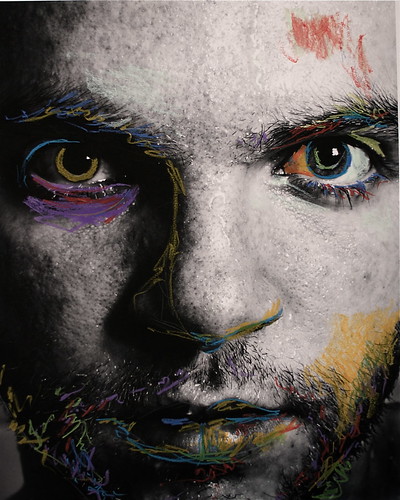
I finished this piece a few weeks ago for a required school assignment. I'd been toying with the idea of manipulating photos through various mediums over the past few months and have recently jumped head-first into the pool.

I suppose I was originally inspired by the works of Christo and Jean-Claude a few years back. I was obsessed with Christo's draftsmanship when applying pastel and various other mediums to schematic photographs. For those of you unfamiliar, first: what have you been doing with your life, and second: here's a link.

There will be a lot more of this work coming out of my studio these next couple months. My newest series is driven by memory: I plan to blow up (massive) old black and white photographs and apply washes of color in attempt to recreate how I remember them at the point of when they were initially shot. Exciting, no question.